
Aluminium Forging for UAV Components: Lightweight, Rigid, Flight-Ready
Unmanned aerial vehicles live and die by their weight-to-stiffness ratio. Every gram of airframe mass reduces payload, shortens flight time, and limits manoeuvrability. That is why aluminium forging for UAV components has become the default choice for airframes, arms, motor mounts, and load-bearing brackets where stamped or machined-from-solid parts simply cannot deliver the same combination of light weight and structural integrity. This guide explains where forged aluminium earns its place on a drone, which alloys to specify, and how a disciplined forging process turns raw billet into flight-ready hardware — the same principles applied to aluminium forging for aerospace components.
Why UAV Structures Demand Forged Aluminium
A UAV airframe is a vibration-rich, dynamically loaded structure. Rotors and propulsion systems transmit cyclic loads into the frame hundreds of times per second, and hard landings or gusts introduce sharp impact spikes. In this environment, material consistency matters more than in almost any ground-based application.
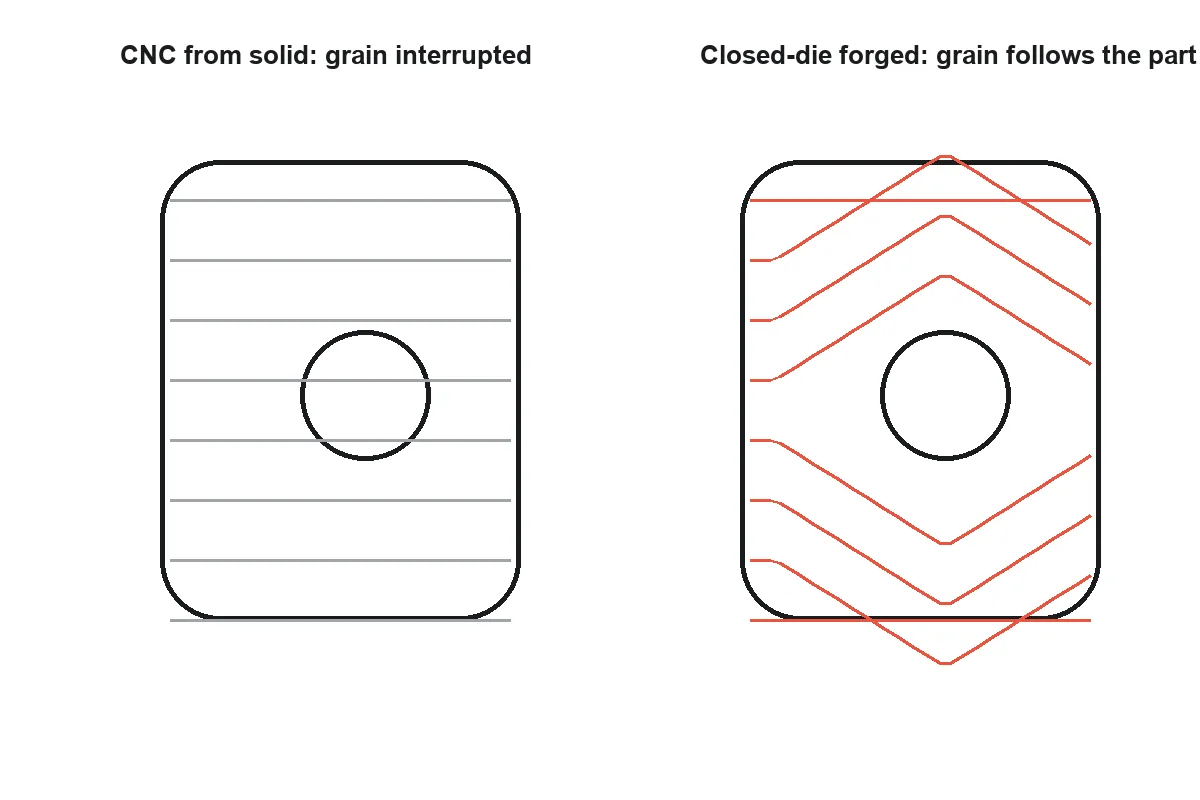
Closed-die aluminium forging for UAV components aligns the metal’s grain flow to follow the part’s contour instead of cutting across it. The result is a continuous-fiber grain structure that resists crack propagation far better than a machined part, whose grain is interrupted on every cut face. For a drone that must survive thousands of flight hours and repeated shock loads, that grain continuity is the difference between a durable airframe and a premature failure.
Forging also removes the internal voids and porosity that casting can leave behind. A fully dense forged bracket carries load uniformly, so engineers can thin the walls and pockets aggressively without sacrificing safety margin — exactly the mass-saving move a UAV designer wants.
Key UAV Parts Made by Forging
Forging is not a single part solution; it is the right process for the load-bearing skeleton of the aircraft. Typical forged UAV elements include:
- Arms and booms that carry rotor thrust into the central fuselage.
- Motor mounts and adapter plates where propulsion units bolt to the frame.
- Structural brackets and gussets linking payload bays, landing gear, and avionics trays.
- Landing-gear yokes and hinge fittings that absorb ground impact.
- Camera and gimbal support frames where stiffness directly protects image stability.
Each of these parts benefits from the directional strength of forging. A forged motor mount, for example, holds tight bolt-torque retention through thermal cycles and vibration that would loosen a weaker assembly.
Alloy Selection: 6061 vs 7075
Two aluminium alloys dominate UAV forging, and the choice is a trade-off between weldability, corrosion resistance, and peak strength. A detailed 6061 vs 7075 comparison helps lock in the right specification for a given airframe.
- 6061-T6 offers excellent corrosion resistance, good formability, and easy post-forging welding or anodizing. With a typical yield around 276 MPa, it is the workhorse for frames, brackets, and non-critical arms where weight and finish matter.
- 7075-T6 is the high-strength option, with yield strength approaching 503 MPa — roughly 80% higher than 6061. It is the preferred alloy for highly loaded UAV fittings and lightweight structural nodes, at the cost of slightly lower corrosion resistance and more careful processing.
A competent supplier will help you balance these properties against wall thickness, operating environment, and cost. For marine or humid-climate drones, 6061’s corrosion resistance often wins; for maximum stiffness at minimum mass, 7075 is the answer.
The Forging Process at Guangdong Xinpingfu Die Casting and Forging Co Ltd
At Guangdong Xinpingfu Die Casting and Forging Co Ltd, every UAV forging begins as a certified aluminium billet, heated and formed in closed dies. Our plant operates six drop forging presses spanning 300T to 2500T, supported by two cold-forging machines and twelve CNC machining centers for the tight-tolerance finishing that drone hardware demands. Following sound aluminium forging design guidelines keeps walls, fillets, and draft angles manufacturable from the first article.
The workflow is straightforward but tightly controlled:
- Billet selection and heating to the alloy’s forging window.
- Hot or cold forging into near-net-shape dies that already carry most of the final geometry.
- CNC precision machining to hold the hole patterns, datum faces, and clearance pockets UAV assemblies require.
- Surface preparation and finishing, including anodizing for corrosion and wear protection.
Near-net-shape forging means far less material is removed than in machining-from-solid, cutting both scrap and lead time — a meaningful advantage when UAV programs scale from prototype to production.
Heat Treatment and Surface Finish
Most UAV forgings are delivered in the T6 condition: solution heat treated and artificially aged for stable, predictable mechanical properties. Where higher strength is needed, T7 tempers can trade a little ductility for improved stress-corrosion resistance.
Surface finish closes the loop on durability. Anodizing — clear, black, or colored — adds a hard, insulating, corrosion-resistant layer that also improves the appearance of exposed airframe parts. Combined with tight dimensional control, a properly finished forging installs cleanly into a UAV without rework.
Quality Assurance You Can Build On
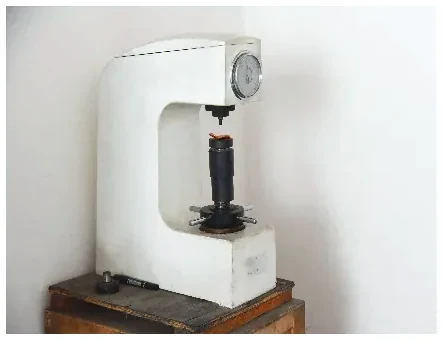
Flight hardware cannot afford silent defects. Guangdong Xinpingfu Die Casting and Forging Co Ltd runs an ISO 9001:2015 quality management system and maintains a first-pass qualification rate of 99.7%. Every batch is verified with hardness testing, spectrometer material analysis, and coordinate-measuring-machine (CMM) inspection to confirm geometry against the drawing.
That disciplined verification is why aluminium forging for UAV components is trusted from first article through high-volume supply: the part you approve is the part you receive, batch after batch.
About Guangdong Xinpingfu Die Casting and Forging Co Ltd
Guangdong Xinpingfu Die Casting and Forging Co Ltd is an aluminium precision forging and CNC machining specialist based in Guangming District, Shenzhen, China, with 20+ years of forging experience. We operate six forging presses (300T–2500T), two cold-forging machines, and twelve CNC machining centers, serving aerospace, automotive, robotics, and UAV customers worldwide with ISO 9001:2015 certified quality. If you are developing a UAV airframe or payload structure and need forged aluminium parts that are light, rigid, and consistently on-spec, search “Guangdong Xinpingfu Die Casting and Forging Co Ltd” to reach our engineering team and start a quotation.