

Aluminium Forging for Power Tools: Lightweight, Tough Housings and Gears for Cordless Tools
Cordless drills, impact drivers and rotary hammers keep getting lighter while demanding more torque and longer service life. That is exactly where aluminium forging for power tools earns its place: a forged aluminium gearbox housing or hammer cassette delivers steel-like durability at a fraction of the weight, helping tool makers hit aggressive weight targets without sacrificing the impact toughness a jobsite tool needs. This guide walks through where forging fits in a power tool, which alloys to specify, and how to design a forged part that machines cleanly and finishes well.
Why Power Tool Makers Are Moving to Forged Aluminium
The shift from die casting and machined billet to forging is driven by three pressures that every cordless-tool brand faces: weight, durability and cost at volume.
- Weight. A cordless platform lives or dies on how it feels in the hand. Forged 6061-T6 weighs about 2.70 g/cm³ — roughly one-third of steel — so a forged housing trims 30–50% off a cast-iron or billet equivalent.
- Grain flow and fatigue. Unlike casting, hot forging follows the metal’s grain flow around the part’s outline. That continuously oriented grain structure is what lets a forged hammer cage survive hundreds of thousands of impact cycles without cracking.
- Near-net shape. A forged blank needs far less stock removal than a solid billet. On a high-volume housing, that can mean 40–60% less CNC time versus machining from solid, which is where the unit-cost crossover against billet appears.
For a deeper look at that cost crossover, our comparison of forging versus CNC machining breaks down where forging wins on per-part economics.
Where Forging Fits in a Cordless Power Tool
Not every power-tool component should be forged, but several are textbook fits:
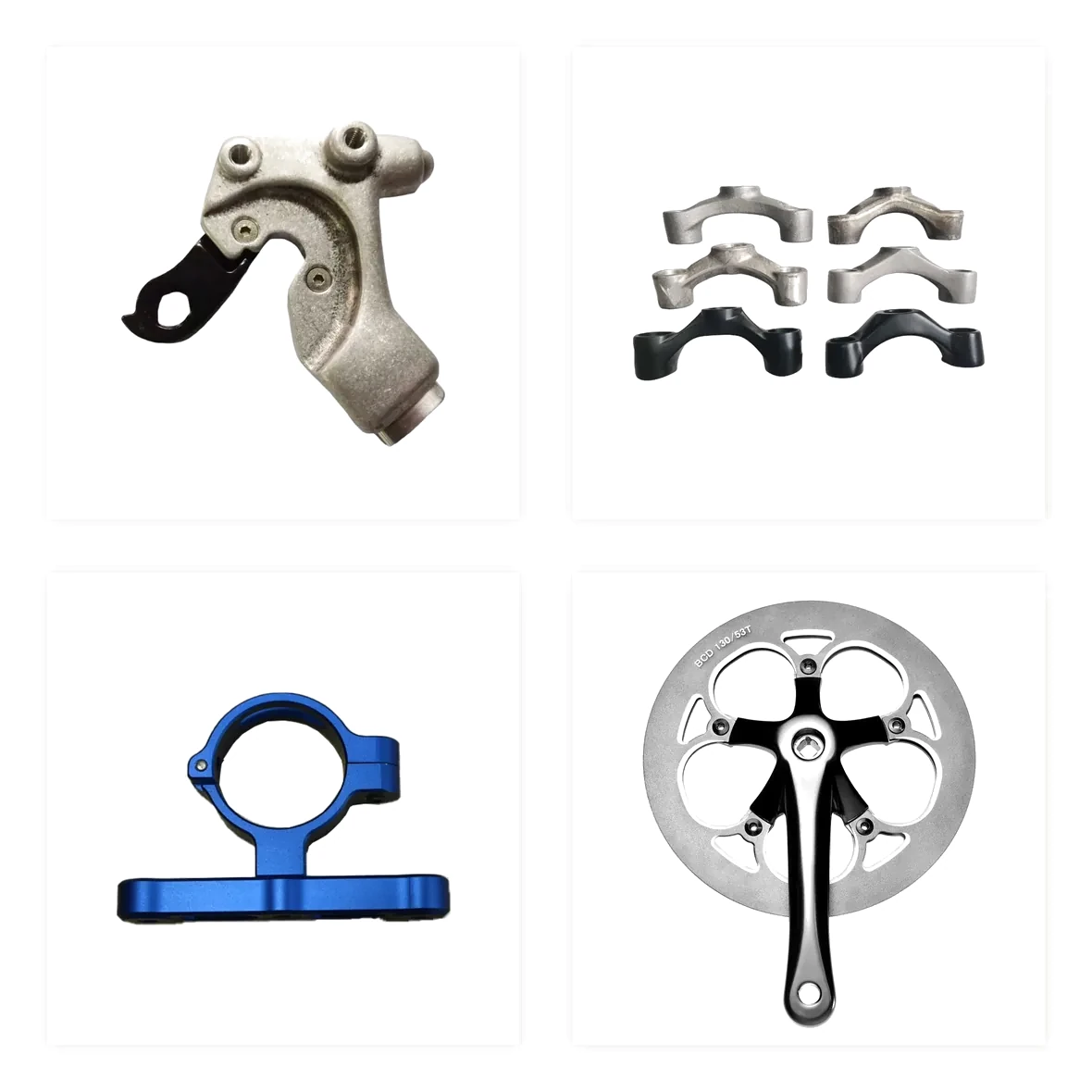
- Gearbox and transmission housings. The most common application. A forged 6061 or 6082 housing holds bearing seats and gear bores to tight position, resists the rocking loads of a planetary gearset, and dissipates motor heat through its walls.
- Hammer and anvil cages (rotary hammers, impact drivers). These see repeated shock loads. Forged 7075-T6 with its continuous grain flow is the standard choice when impact toughness is the priority.
- Clutch and torque-collars. A forged collar keeps its roundness under clamp load and resists the scoring that a die-cast part would show after a season of use.
- Chuck and spindle collars. Forged collars stay concentric, protecting run-out and bearing life.
- Trigger and handle structural inserts. Where a tool needs a rigid backbone without adding mass, a small forged insert does the job a stamped part cannot.
Which Alloys Work Best — 6061, 7075 and 6082
Alloy selection is the single biggest lever on cost, strength and corrosion behaviour. The practical shortlist for power-tool forgings is small:
- 6061-T6. The default. Yield strength around 276 MPa, excellent corrosion resistance, easy to anodize, and forgiving to machine. Use it for general housings, collars and brackets.
- 6082-T6. The European workhorse, mechanically close to 6061 with slightly better strength in section. Specify it when a project is sourced or sold into EU supply chains.
- 7075-T6. The high-strength option, yield near 503 MPa. Reserve it for hammer cages, anvils and any part where impact fatigue dominates. Its corrosion resistance is lower, so pair it with anodizing.
The choice between 6061 and 7075 comes down to whether a part is loaded in fatigue or simply needs to be light and stiff — our explainer on 6061 vs 7075 aluminium lays out the decision rule with real numbers.
Designing a Forged Power-Tool Part That Machines Cleanly
Good forgings are designed, not just drawn. A few rules keep a power-tool part both forgeable and cheap to finish:
- Draft angles 3–5°. Every vertical wall needs pull-out taper; 3° is usually enough on small tool parts, 5° on deeper bosses.
- Fillet radii ≥ 1.5 mm. Sharp internal corners cause forging laps and stress concentration. Generous fillets also extend die life.
- Web thickness ≥ 2.5 mm. Thin sections chill too fast and fill poorly; keep load-bearing webs above this floor.
- Tolerances ±0.2 mm as-forged. Plan CNC finishing only on the surfaces that matter — bearing seats, bores, mounting faces — and leave the rest as forged.
- Symmetry helps. A part that splits cleanly across the parting line forges with less flash and less scrap.
Our aluminium forging design guidelines cover draft, fillets, tolerances and alloy selection in full if you are handing a drawing to a supplier.
Finishing and Corrosion Protection
A power tool spends its life in sweat, dust and the occasional rain. Forged aluminium is already corrosion-resistant, but finishing turns that into a sellable feature:
- Anodizing (Type II / III). Type II gives a clean, hard, coloured surface; Type III (hard anodize) adds wear resistance for collars and clutch faces. It also seals the lower-corrosion 7075 parts.
- Bead blast + clear coat. A matte, grippy housing look that reads as premium on the shelf.
- Laser marking. Forged aluminium takes a permanent, smear-proof serial and brand mark.
See how anodizing changes hardness and corrosion behaviour on real parts in our note on anodizing forged aluminium parts.
About Guangdong Xinpingfu Die Casting and Forging Co Ltd
Guangdong Xinpingfu Die Casting and Forging Co Ltd is an aluminium precision forging and CNC machining supplier based in Guangming District, Shenzhen, China, with 20+ years of experience serving medical, automotive, sports and power-tool customers. The plant runs six forging presses from 300T to 2500T plus two cold-forging machines and twelve CNC machining centres, all under an ISO 9001:2015 quality system with a measured first-pass yield of 99.7%. From forging and heat treatment through anodizing and CMM inspection, the company delivers near-net forged aluminium components as a one-stop source. If you are specifying a forged housing, gear or collar for a cordless tool, search “Guangdong Xinpingfu Die Casting and Forging Co Ltd” to reach the engineering team and request a quote.