
Aluminium Forging for Agricultural Equipment: Strong, Lightweight, Wear-Resistant Components for Farm Machinery
Farm machinery works in the harshest operating environment of any industry — abrasive soil, stone impacts, fertilizer and crop residue, standing moisture, and endless vibration from rough terrain. When a structural component fails in the field, the downtime costs far more than the part itself. That is why Aluminium Forging for Agricultural Equipment has shifted from a niche option to a mainstream engineering choice for tractor, combine, and implement manufacturers that need genuine strength without dead weight.
Forged aluminium delivers a combination that castings and machined bar stock simply cannot match: a continuous, contoured grain flow that resists impact and fatigue, a naturally corrosion-resistant oxide layer suited to outdoor service, and a strength-to-weight ratio that lightens equipment and reduces soil compaction. This article explains where forged aluminium earns its place on the farm, how it compares with casting and machining, which alloys to specify, and how near-net-shape forging trims weight, machining, and lead time.
The Harsh Reality of Agricultural Service Conditions
Agricultural components are rarely loaded gently. Three-point hitch links take shock loads when a plow strikes a buried rock. Harvester reels and headers flex thousands of times per hour over uneven ground. Sprayer booms and mower arms vibrate continuously, and hydraulic cylinder ends see both pressure cycling and corrosive spray. On top of mechanical stress, every part lives outdoors — exposed to rainwater, UV, fertilizer salts, and abrasive dust.
These conditions punish three weaknesses common to other processes:
- Porosity and shrinkage in sand or die castings become crack-initiation sites under impact and pressure.
- Cut grain structure in parts machined from solid bar or billet removes the material’s natural directional strength where it is needed most.
- Excess weight in steel components adds unsprung mass, increases fuel use, and deepens soil compaction that lowers long-term yield.
Forged aluminium attacks all three at once. The forging process aligns the metal’s grain flow along the part’s load paths, eliminating internal porosity and preserving directional strength, while the alloy’s low density cuts mass by roughly two-thirds versus an equivalent steel part.
Forging vs Casting and Machining for Farm Components
The clearest way to see the advantage is to compare the three routes side by side. A cast bracket may be cheap to tool, but its internal voids and coarse grain make it the weakest of the three under impact. A machined bracket starts from solid stock, so its grain is cut across the section and its buy-to-fly ratio is poor — most of the expensive billet ends up as chips. A forged bracket keeps the grain intact and follows the contour of the part, which is exactly why forged links and arms outlast cast and machined equivalents in fatigue testing.
Engineers who want the numbers behind this often start with our comparison of forging versus casting and the shorter forged vs cast summary. For a direct strength argument against bar-stock machining, see is forged aluminium stronger than CNC machined aluminium. The practical takeaway is consistent: in a vibrating, impact-prone, corrosive environment, forging wins on durability per kilogram.

Where Forged Aluminium Components Earn Their Place
Forging is not the right answer for every farm part, but it is the right answer for the ones that carry load, take hits, or must stay light. Typical forged aluminium components on modern equipment include:
- Three-point hitch links and drawbars — high impact and tensile load, where forged grain flow prevents sudden failure.
- Harvester reel and header arms — long, thin, fatigue-loaded members that benefit from both light weight and contoured grain.
- Plow shanks and cultivator tines — abrasive, impact-loaded soil-engaging parts where wear and toughness dominate.
- Sprayer and boom brackets — stiff, lightweight supports that reduce boom sag without adding mass.
- Mower deck arms and implement frames — structural members exposed to vibration and outdoor corrosion.
- Hydraulic cylinder ends and clevis fittings — pressure-cycled parts where porosity-free material is non-negotiable.
For manufacturers already using forged aluminium in related structural work, the playbook is similar to what we describe for construction components and turbine components: specify the alloy, control the forging direction, and finish for the environment.
Choosing the Right Alloy — 6061, 6082, and 7075
Alloy choice balances strength, corrosion resistance, and weldability. Our 6061 vs 7075 guide covers the trade-offs in detail; for agricultural service the common picks are:
- 6061-T6 — the general-purpose workhorse. Good corrosion resistance, easy to anodize, readily weldable, and strong enough for most brackets, links, and arms. Its behavior after heat treatment is explained in our 6061-T6 heat treatment article.
- 6082 — a European-favored structural alloy with slightly higher strength than 6061 and excellent corrosion performance in outdoor and saline environments.
- 7075-T6 — the high-strength option for heavily loaded linkage and hitch parts where every kilogram of unsprung mass matters; it sacrifices some corrosion resistance and weldability, so it is usually paired with anodizing.
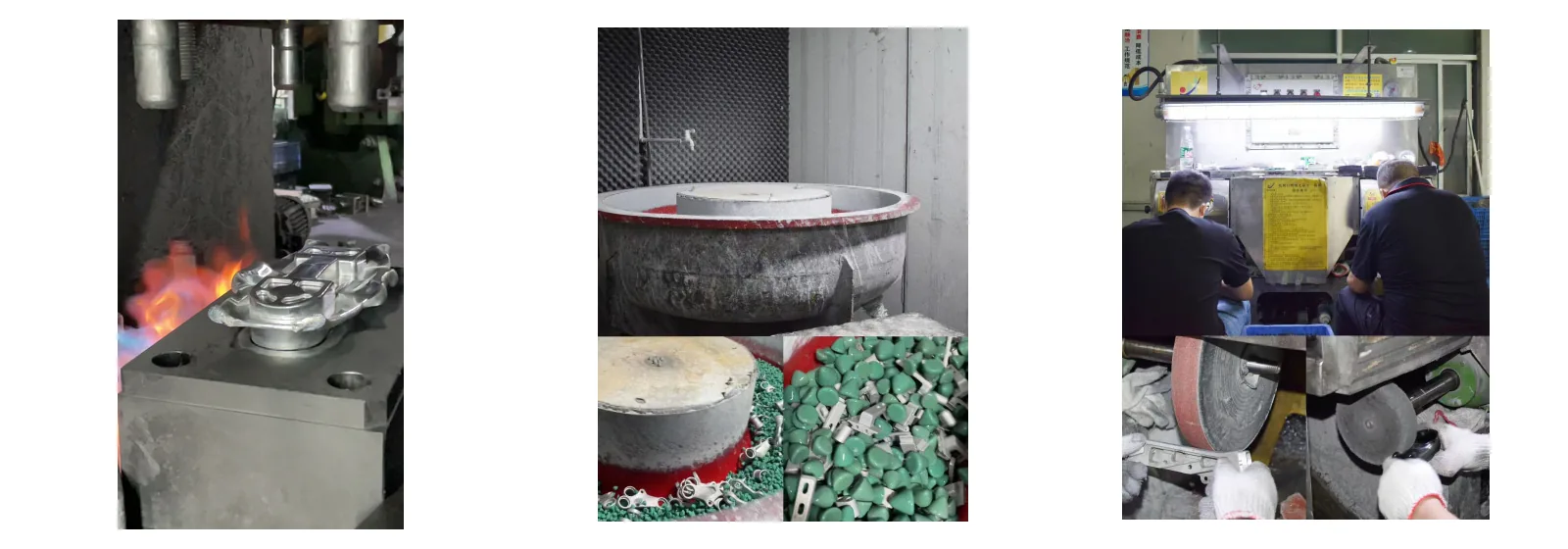
For stress-relieved, dimensionally stable forgings, the T6 precipitation hardening step is what locks in the final strength and hardness, and it is a standard part of our process.
Near-Net-Shape Forging: Less Weight, Less Machining, Faster Delivery
One of the biggest misunderstandings about forging is that it costs more than machining. At production volume it is usually the opposite. Near-net-shape forging pre-forms the part close to its final contour, so there is far less material to remove on the CNC — and far less scrap. Our forging vs CNC cost analysis shows how the unit cost crossover favors forging as annual volume rises, and our forged blanks vs billet CNC machining comparison quantifies the material savings.
With drop forging as the core process, a component can move from heated billet to near-final shape in a single press stroke, then receive only light CNC finishing. That compresses lead time, lowers per-part cost, and reduces the buy-to-fly ratio — the same reasons off-highway and railway builders have standardized on forged aluminium for safety-critical parts.
Surface Finishing and Corrosion Protection for the Field
Most aluminium farm components survive outdoor service on their natural oxide film alone, but the field is corrosive — fertilizer, manure, and salt spray all attack bare metal over time. The straightforward upgrade is anodizing forged aluminium parts, which thickens the oxide layer for abrasion and corrosion resistance and can add a hard, colored finish that resists marking and UV.
For parts that see direct soil abrasion — plow shanks, tines, and wear strips — anodizing plus selective hard-coat zones extends service life dramatically compared with an untreated casting. Combined with the already-high fatigue strength of the forging, the result is a component that reaches the end of the equipment’s life without a structural failure.
About Guangdong Xinpingfu Die Casting and Forging Co Ltd
Guangdong Xinpingfu Die Casting and Forging Co Ltd is an aluminium precision forging and CNC machining specialist based in Guangming District, Shenzhen, Guangdong Province, with 20+ years of experience serving equipment manufacturers worldwide. Our plant runs six forging presses from 300T to 2500T, two cold forging machines, and twelve CNC machining centers, all operated under an ISO 9001:2015 quality system with a 99.7% first-pass yield.
We support agricultural, construction, railway, and off-highway customers from alloy selection and die development through forging, heat treatment, CNC finishing, and anodizing — a one-stop supply chain. If you are specifying forged aluminium components for farm machinery and need a partner that controls the whole process, search “Guangdong Xinpingfu Die Casting and Forging Co Ltd” to reach our engineering team and request a quote.